Heyball vs Pool: The Key Differences, Rules & Fouls Every Player Needs to Know
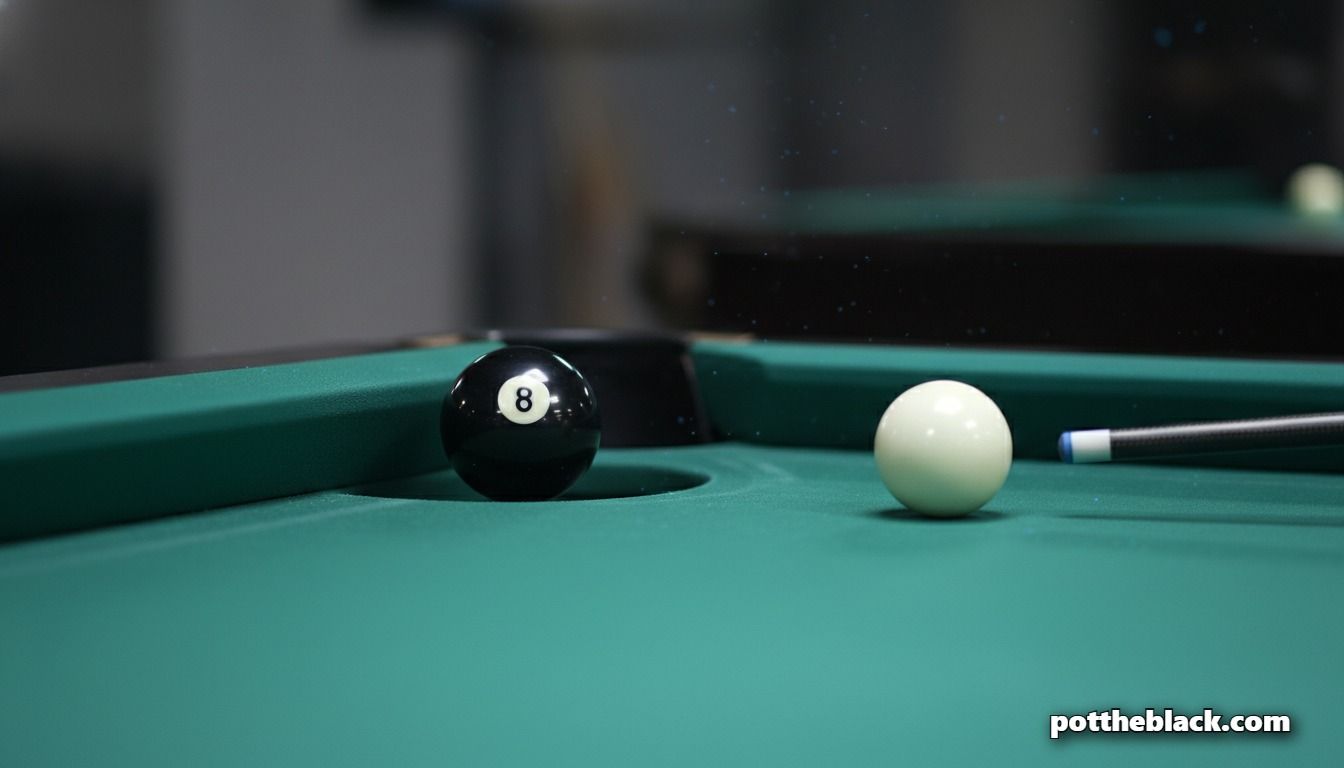
Heyball, also known as Chinese 8-ball, is a hybrid cue sport played on a 9-foot table sized like standard pool but fitted with snooker-tight pockets. It uses the same 2¼ inch balls as American pool, doesn't require called shots, and rewards a level of precision closer to snooker than pub pool.
That combination is exactly why it's exploded in popularity over the last few years.
If you've been watching cue sports news lately, you'll have noticed Heyball turning up everywhere — major tournaments, record prize pools, world-class players crossing over from 9-ball and snooker. It's no longer a curiosity. It's one of the fastest-growing competitive disciplines on the planet.
There's still a lot of confusion at club level though, about what Heyball actually is, how it differs from the 8-ball most of us grew up playing, and what happens when things get complicated at the table. This is the definitive breakdown. Heyball vs pool — the differences, the rules, and every foul you need to know.
What Is Heyball?
Heyball — also called Chinese 8-Ball — originated in China in the 1980s. The idea was to combine the tactical accessibility of American 8-ball with the technical brutality of snooker. Over the following decades it spread across Asia, then globally. Today it is governed by the World Pool-Billiard Association (WPA) and the International Heyball Pool Association (IHPA), and is played competitively in over 60 countries.
Prize money at major Heyball events has now surpassed the World Snooker Championship, making it the most lucrative cue sport in the world by that measure. That's not a typo.
Heyball vs Pool: The Key Differences
The Table
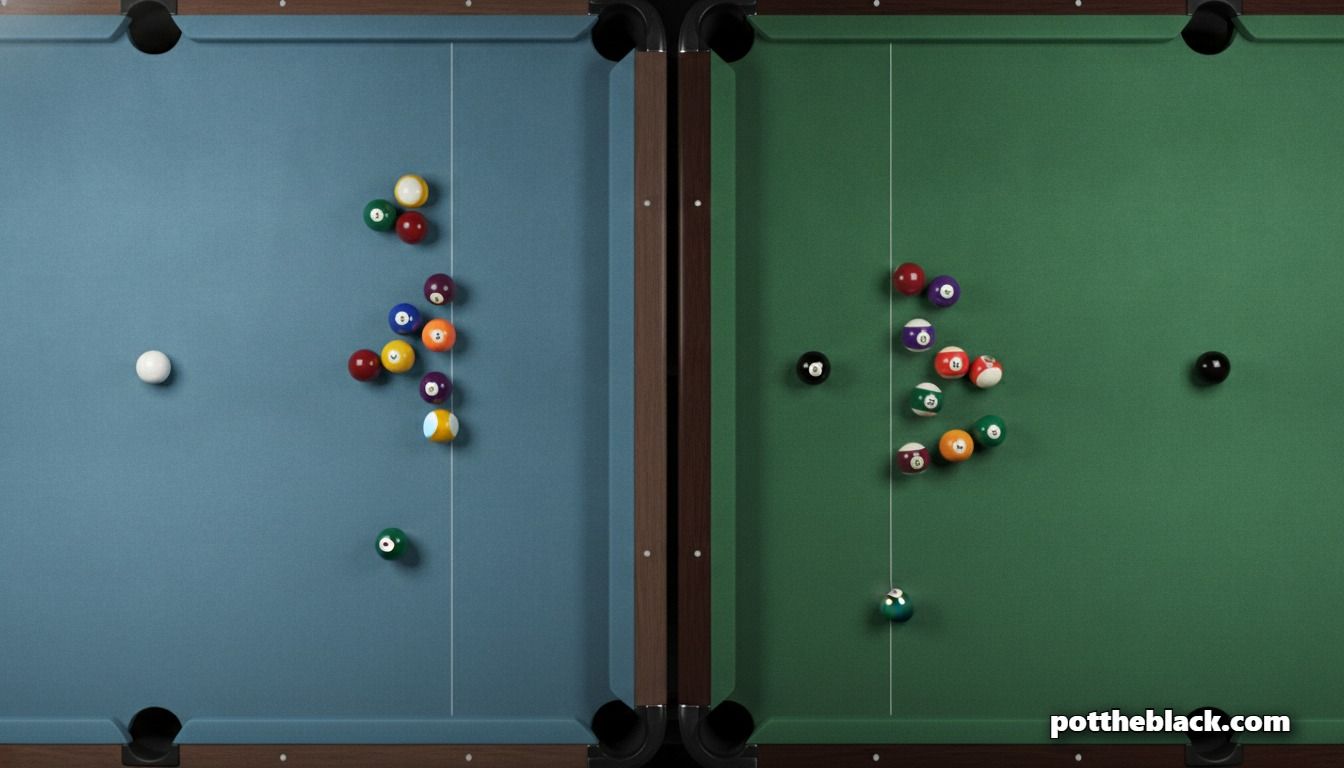
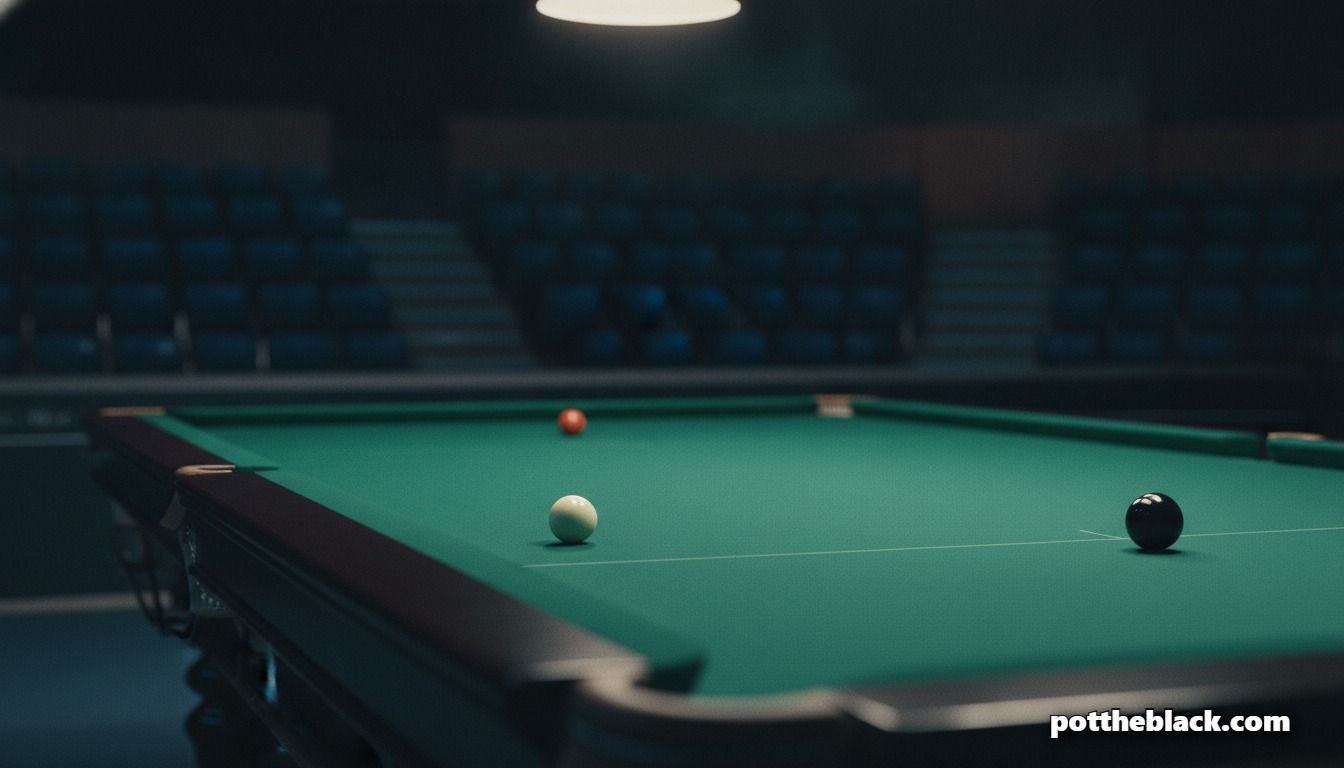
At first glance a Heyball table looks identical to a standard pool table — it's a 9-foot table with six pockets. But the similarities end there.
Heyball tables use heavy napped or worsted snooker-style cloth and snooker-style steel block cushions. The critical difference is the pocket openings. Standard American pool pockets are wide and angled, forgiving enough to accept a ball that clips the jaws. Heyball pockets are tight and rounded — snooker-style — meaning a ball that hits the pocket entrance at the wrong angle rattles out. Every time. No luck, no cheating the pocket. It's been called the ultimate truth-teller in billiards for exactly this reason.
The Balls
Same size as standard pool — 2¼ inch American balls at 156–170g. This is where Heyball departs from snooker, which uses smaller, lighter balls. The heavy American ball on snooker-tight pockets is what creates Heyball's signature combination of power and precision.
The Cue
A standard 13mm pool cue is too wide for consistent control through tight pockets. A 9mm snooker cue lacks the mass to drive heavy American balls without deflection. Most serious Heyball players use specialised cues with tip sizes between 11.5mm and 12.5mm — a deliberate hybrid designed for this game.
Groups: Solids and Stripes — But Different
In standard 8-ball, the groups are 1–7 (solids) and 9–15 (stripes). In Heyball the split is the same, but the tactical patterns differ significantly because of the tight pockets — routes that work comfortably on a standard pool table simply don't exist on a Heyball table. If you want a refresher on how 8-ball groups and turns work under standard rules, our 8-ball rules reference covers that in full.
No Called Shots
This is one of the biggest rule differences for players crossing over from standard pool. In Heyball, you do not call your shots or pockets. Flukes are completely legal. This speeds the game up significantly and eliminates a huge source of arguments at the table. Under WPA 8-ball, called shots are required — one of several places where the two disciplines genuinely diverge.
The Skill Shot
Here's a tactical element that has no equivalent in standard 8-ball. In Heyball, you are allowed to pot your opponent's ball without penalty, provided you legally pot your own ball during the exact same shot. This opens up clearance patterns where you remove a blocker while simultaneously potting your own ball — a genuine tactical weapon that rewards creativity.
Equal Prize Money
Heyball is currently the only major cue sport discipline that mandates equal prize money for men's and women's championships. That's a meaningful distinction and part of why the sport has grown its global audience so quickly.
Heyball vs Pool
Heyball Rules: The Full Breakdown
The official rules are published by the WPA and IHPA. You can read the full WPA Rules of Heyball and the IHPA Rules of Heyball directly. What follows is a plain-English breakdown of the key sections.
The Rack
Balls are racked in a triangle with the apex on the foot spot. The 8-ball sits at the centre of the triangle. One solid and one stripe are placed at each corner of the base, with remaining solids and stripes separated as far as possible. Racking is the referee's responsibility — players do not rack their own balls in sanctioned play.
The Break
The break rules in Heyball are strict and genuinely consequential:
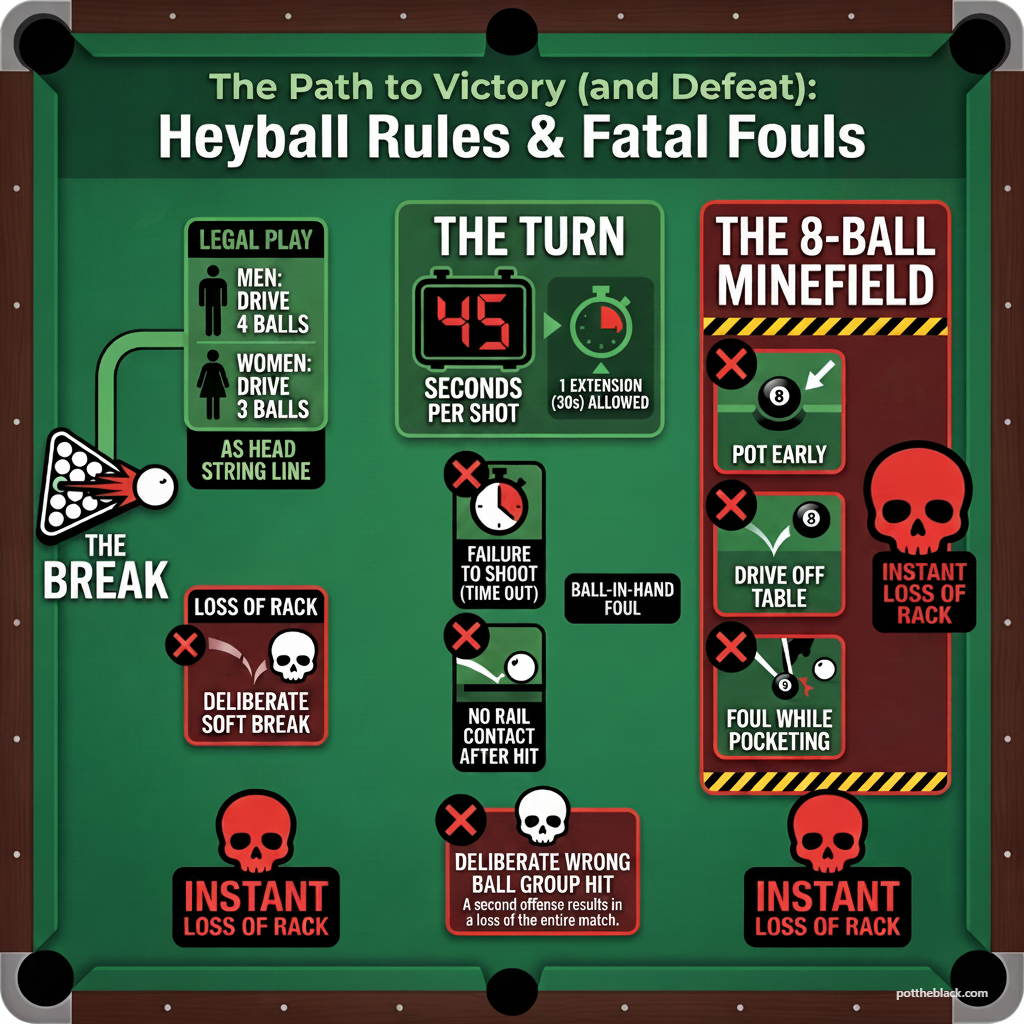
- Soft breaks are not allowed. If fewer than four object balls are driven to one or more rails, it is treated as an intentional attempt to slow the game and results in loss of rack.
- If you scratch on the break, the incoming player gets ball-in-hand — but it must be played from behind the head string.
- Pocketing the 8-ball on a legal break is not a foul — specific tournament rules will determine whether this results in a re-rack or a win.
Open Table
Before groups are determined, the table is "open." If the shooter legally pockets a ball, that group becomes theirs and the opponent takes the other. If they fail to legally pocket a ball, the table remains open and play passes to the opponent.
Ball in Hand
If the shooter commits a foul, the opponent gets cue ball in hand — anywhere on the table unless the foul occurred on the break, in which case ball in hand is restricted to behind the head string.
The Shot Clock
Players are typically allowed 45 seconds per shot. A reminder is given when 10 seconds remain, with a countdown at 5 seconds. Timing begins when all balls are still and ends when the cue tip contacts the cue ball. Each player may call one extension per rack, usually 30 seconds. Failing to shoot within the time limit is a foul.
Winning the Rack
Pot all your group balls, then legally pot the 8-ball. If the 8-ball is driven off the table, it is loss of rack.
Heyball Fouls: Standard Fouls
A standard foul results in cue ball in hand for the opponent. If you want to compare these against standard 8-ball fouls side by side, see our pool fouls reference guide which covers both disciplines in detail.
The following are standard fouls under WPA/IHPA Heyball rules:
Scratch — Potting the cue ball on any shot other than the break.
No rail after contact — After the cue ball contacts an object ball, either the cue ball or an object ball must reach a cushion, or an object ball must be pocketed. Failing this is a foul.
Wrong ball first — The cue ball must contact one of your own group balls first. Hitting the opponent's ball or the 8-ball first (before your group is cleared) is a foul.
Ball off the table — Driving any ball off the table is a foul. The ball is spotted — except the 8-ball, which is loss of rack.
Double hit — If the cue stick contacts the cue ball more than once during a shot, it is a foul. This commonly happens on soft shots where the cue ball is tight to another ball or the cushion.
Balls still moving — Playing a shot while any ball is still moving or spinning is a foul.
Playing out of turn — It is a standard foul to unintentionally play out of turn.
Shot clock violation — Failing to shoot within the allotted time is a standard foul.
Foot on floor — At least one foot must be on the floor during any shot. Lifting both feet is a foul.
Head string foul on break — When the cue ball is in hand behind the head string, and the first ball the cue ball contacts is also behind the head string, the shot is a foul unless the cue ball crosses the head string before that contact.
Touched ball — Under the WPA's updated 2025 rules, accidentally moving any ball — not just the cue ball — is a foul in sanctioned Heyball play.
Loss of Rack Fouls
These are more serious infractions that result in the immediate loss of the ongoing rack:
Potting the 8-ball early — Pocketing the 8-ball before clearing your group is an automatic loss of rack.
8-ball off the table — Driving the 8-ball off the table at any point is loss of rack.
Illegal soft break — Deliberately breaking too softly (fewer than four balls reaching a rail) is loss of rack.
Second intentional foul — A player's first intentional foul results in losing a rack; a second intentional foul results in losing the entire match.
Heyball Rules and Fouls
Why Pool Players Struggle With Heyball
The tactical patterns are familiar — clear your group, play the 8. But three things consistently trip up experienced pool players making the switch:
Pocket speed. On standard pool tables, you can drive balls hard into wide pockets and they'll drop. On Heyball tables, the same shot rattles out. You have to learn a new relationship between pace and pocket entry angle for almost every shot on the table.
The break requirement. Most pub pool players have a relaxed, controlled break. In Heyball, that gets you a loss of rack. You need power and spread — four balls to a rail minimum — which requires a fundamentally different break technique. Our article on the perfect 8-ball break covers the mechanics of generating power, which translates directly into Heyball break prep.
The skill shot. Pool players aren't used to looking for opportunities to legally pocket the opponent's ball. In Heyball it's a legitimate tactical weapon and ignoring it means leaving points on the table.
FAQ.
Is Heyball the same as Chinese 8-Ball?
Yes — Heyball is the internationally recognised name for what was originally called Chinese 8-Ball. The IHPA standardised the name as part of its push to establish the sport globally.
Can you pot your opponent's balls in Heyball?
Yes, but only if you legally pot one of your own balls on the same shot. Potting only the opponent's ball without potting one of your own is a foul.
What happens if you pot the 8-ball on the break in Heyball?
Under WPA/IHPA rules, pocketing the 8-ball on a legal break is not a foul. Whether it results in a win or a re-rack depends on tournament rules — check with the organiser before you play.
What is the shot clock in Heyball?
45 seconds per shot is the standard, with a 30-second extension available once per rack. Running out of time is a standard foul — cue ball in hand for the opponent.
Do Heyball rules require called shots?
No. Unlike WPA 8-ball rules, Heyball does not require called shots or pockets. Flukes and combination shots are completely legal.
Is Heyball played internationally?
Yes — it is governed by the WPA and IHPA and played in over 60 countries, with major events including the WPA Heyball World Cup and World Heyball Masters Grand Finals.
Where can I read the official Heyball rules?
The full rules are available on the WPA website and via the IHPA. Our own rules reference library covers 8-ball, 9-ball and snooker if you need those alongside.

About Rob St George
Rob St George has been playing pool and snooker at club level for over two decades. Based in Auckland, he created Pot The Black to be the definitive technical resource for serious cue sports players — covering everything from shot mechanics to competitive rules, without the fluff.
More from the Table
Cue Sports Weekly - Wu Yize Wins Shenzhen, O'Sullivan Gets His Lifeline, and the Race for York Tightens
Cue Sports Weekly - Brennan Takes the 8-Ball Worlds, Shenzhen Open Hits the Last Eight