The Real Hustlers: 6 Pool Sharks Who Turned the Baize into a Bank Vault
I've seen plenty of guys who think they're sharks because they cleared a messy table once in a pub match.
There's a difference between playing well and hustling. A massive one.
Hustling isn't just being good at pool. It's disguising how good you are, long enough to get someone to bet more than they should. There's a proper word for it too: sharking is when a hustler works to distract or unsettle an opponent mid-game, and sandbagging is when they deliberately play down, missing shots they'd normally make, to build a bigger prize later. Neither of those things show up on a scoreboard. They show up in someone's wallet, days later, once they've worked out what happened.
Before every tournament was streamed on YouTube and every second player had a carbon fibre shaft, pool was played for rent money as much as trophies. Whole subcultures of "road players" travelled the States from pool hall to pool hall looking for a game, a mark, and a payday. Some of them became legends. A couple of them became so good at hiding their skill that they ended up hiding it from history too.
If you're going to respect this game, you should know their names.
What actually makes someone a hustler
Before we get into the names, it's worth being clear on the terms, because they get thrown around loosely.
A hustler is someone who deliberately disguises their skill level to win money off an opponent who thinks they've got a real chance. It's a form of match manipulation dressed up as a friendly bet.
A stakehorse is the person bankrolling the hustler. They put up the cash for the bets and take a cut of the winnings, without necessarily playing a shot themselves.
A sneaky pete is a plain-looking cue that's actually high quality gear, built to look like a house cue so nobody clocks that the guy holding it has been practising for twenty years.
Sandbagging is playing below your ability early on, so your opponent thinks the game's easier than it is, right up until the bet gets bigger.
Keep those in your head. They'll come up again.
The Showman: Minnesota Fats
You can't start anywhere else. Rudolf Wanderone, who spent most of his life going by Minnesota Fats, wasn't actually the best player of his era. Willie Mosconi and plenty of the other touring pros could beat him straight up, and did.
But Fats didn't need to be the best player in the room. He needed to be the loudest, the funniest, and the most unnerving. He'd walk in dressed like money, talk nonstop, and have you laughing or fuming before a single ball had dropped. Once you were rattled, your stroke went with it.
His fame really took off after The Hustler came out in 1961. Wanderone spent the rest of his life insisting Jackie Gleason's character was based on him, which the book's author always denied. Didn't matter. Fats rode that association into TV appearances and a very comfortable retirement, still talking pool right to the end.
The lesson here hasn't aged: the game starts before you pick up the cue. Let someone into your head and your stroke tightens up whether you notice it happening or not.
The Ghost Name: Efren Reyes
If you only take one name away from this article, make it this one.
Efren Reyes is, by most serious accounts, the best pool player who's ever lived. Two World Championships in two different disciplines, over seventy international titles, and a résumé most players would trade a limb for. But before any of that, he was hustling American pool rooms under a fake name.
In the 1980s, Reyes left the Philippines for the United States and started playing as "Cesar Morales." Nobody in the local scene had heard of him, and it stayed that way for a while, because he made absolutely sure of it. Reports from the time put his weekly earnings from hustling at around eighty thousand US dollars, which for a guy nobody had heard of, in rooms full of players who thought they had the edge, is a genuinely wild number.
What makes Reyes different from most names on this list is that the hustle was just the opening chapter. He went on to become a legitimate, undisputed champion, and he's still spoken about with something close to reverence by players who came up decades after him.
The lesson: real skill doesn't need to announce itself. It just needs the right room and the patience to wait for it.
The Natural: Keith "The Earthquake" McCready
If you've seen The Color of Money, you've seen Keith McCready. He played Grady Seasons, the guy who cleans out Tom Cruise's character for a stack of cash in one of the film's most famous scenes. In real life, McCready was arguably more dangerous.
He had a strange, side-arm stroke that looked like it shouldn't work, and it worked anyway. McCready was a proper road player, chasing the biggest game in whatever town he landed in, and he wasn't picky about who he played. By his own account he once took over three hundred thousand dollars off a single opponent connected to organised crime in Detroit, which tells you something about how little fear factored into his decision-making.
The lesson: pressure is a privilege, not a threat. When the stakes go up, don't change your routine. Stick to the shot you'd play if there was nothing on the table at all.uldn't work, but he could pot anything from anywhere.
Keith was a true "road player." He’d travel from town to town, looking for the biggest game in the house. He didn't care about rankings or titles; he cared about the "cash on the wire." He was known for playing "high-stakes" matches where the pressure would make most men crumble. But Keith? He just got sharper.
The Lesson: Pressure is a privilege. When the stakes are up, don't change your routine. Stick to your pre-shot ritual, breathe, and trust the thousands of hours you’ve put in at the table.
The King of Norfolk: Ronnie Lassiter
Ronnie Lassiter isn't a household name the way Fats is, but among people who actually study the history, he's up there with the very best of them.
Norfolk, Virginia, was one of the hottest gambling towns in the country during the Second World War, full of sailors with money and not much else to do with it. Between the early forties and the late forties, Lassiter is said to have won something in the region of three hundred thousand pounds hustling pool there, with individual games sometimes played for a thousand dollars a time. That's an extraordinary sum for that era, made off the back of hand-eye coordination that reportedly bordered on freakish.
Lassiter eventually went on to compete properly and picked up six world championships along the way, proving the hustling years weren't just a con. He could genuinely play.
The lesson: the biggest games are found where the money is loose and the competition is overconfident. Lassiter understood that better than almost anyone.
The Slow Player: Danny McGoorty
Danny McGoorty came up through the Great Depression, drifting between pool halls for decades because there wasn't much else on offer. He wrote a memoir about it, and it's still worth tracking down if you want the unfiltered version of what that life actually looked like.
McGoorty specialised in the slow con. He'd walk in looking dishevelled, miss a few shots that should've been easy, and let someone offer him a game before he'd said a word about wanting one. Then he'd keep the early games tight, winning by a ball here and there, just enough to keep his mark interested and convinced they had a real shot. It's a cynical way to make a living, but for a lot of players in that era, it was the only living going.
The lesson: never judge a player off their first three shots. A real shark hides their gear until the money's actually on the table. Watch the bridge hand and the follow-through, not the scoreline.
The Modern Ghost: "Kid" Delicious
Danny Basavich, better known as Kid Delicious, dragged the whole hustling tradition into the modern era. He didn't look like an athlete. He looked like he'd be more at home at a barbecue than a pool table, and that was exactly the point. Nobody clocked him as a threat until it was too late.
He toured with his partner, Bristol Bob, running the classic double act: Danny playing the bumbling amateur, Bob talking up the game and steering the mark toward a bigger bet. By the time a room worked out Danny was a genuine world-class talent, the money had already changed hands.
The lesson: humility is a weapon in this game. You don't need to tell anyone how good you are. Let the potting do that.
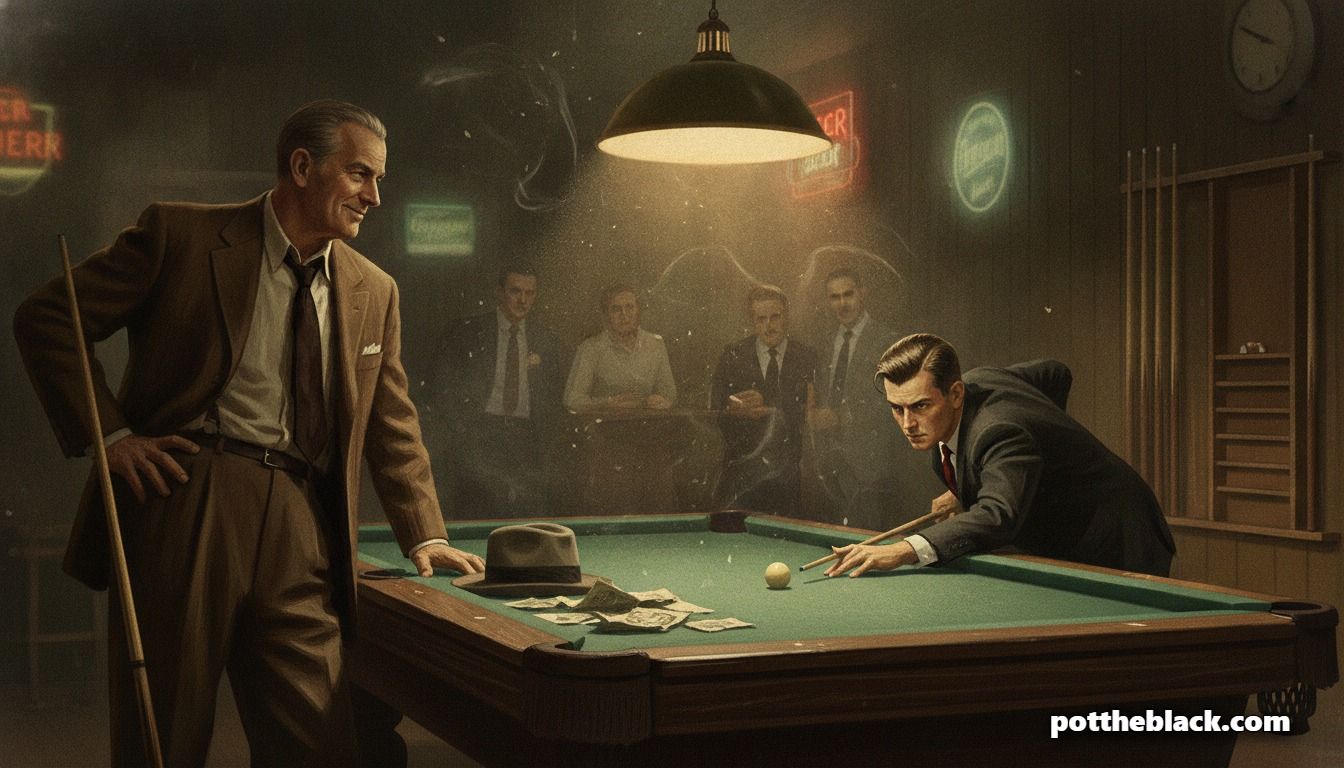
The tricks that never made the highlight reel
Hustling gets most of the attention, but sharking is really its own art form, and some of the tactics that got passed around pool halls are worth knowing, if only so you can spot them.
There's the body noise shark, a well-timed cough or sneeze dropped right as your opponent's cueing up. There's the line of sight shark, where a player wipes their hands with a towel or chalks up right in their opponent's eyeline mid-shot. Onofrio Lauri, an old-school legend, was known for polishing his bald head until it caught the light just right and bounced a glare straight into his opponent's eyes. And then there's the one Minnesota Fats himself was famous for: if the other guy's on a hot streak, stop the match to go eat a sandwich. It sounds ridiculous until you've actually had a run broken by someone doing exactly that.
None of these are strictly against the rules, which is the whole point. They're subtle enough to get away with and disruptive enough to work.
How to spot a modern-day sandbagger
We don't really have road players in New Zealand anymore, but you'll still run into guys underplaying their hand in handicap comps or money matches. If you want to know whether someone's better than they're letting on, there are three things worth watching.
Watch the bridge hand first. A novice's bridge is loose and shaky. Someone who's played for years has a bridge like it's bolted to the cloth, dead still through the power stroke.
Watch the cue ball control next. Anyone can fluke a pot once. But if a guy keeps "accidentally" missing while somehow leaving the white exactly where he needs it for next shot, that's not luck. That's a player.
And watch how they chalk. Real players chalk almost without thinking about it, evenly, as part of their rhythm. If someone's chalking like they're painting a fence, they're overacting the part of a beginner.
Why hustling had to die out
Here's the honest version of it, mate. The hustling era is basically over, and that's probably good for the sport overall.
The internet killed it. You can't walk into a club in Christchurch or Hamilton and play the innocent when there's footage of you winning a regional title sitting on Facebook. Everyone's reputation follows them now, whether they like it or not.
The real risk in trying it today isn't losing a game, it's losing your standing. The pool world here is small. Get a name for sandbagging in club or handicap comps and you'll run out of people willing to play you fairly quickly.
At the end of the day, the physics doesn't care who's holding the cue. The balls only react to the energy you give them. Keep your bridge steady, keep your mouth shut, and play the table instead of the man.
Cheers, Rob
Related reading: check out our full breakdown of pool fouls for Heyball and 8-ball.
About Rob St George
Rob St George has been playing pool and snooker at club level for over two decades. Based in Auckland, he created Pot The Black to be the definitive technical resource for serious cue sports players — covering everything from shot mechanics to competitive rules, without the fluff.
More from the Table
Cue Sports Weekly - Wu Yize Wins Shenzhen, O'Sullivan Gets His Lifeline, and the Race for York Tightens
Cue Sports Weekly - Brennan Takes the 8-Ball Worlds, Shenzhen Open Hits the Last Eight