How to Handle 8-Ball’s Biggest Arguments
There’s nothing that ruins a good night at the club faster than a row over the rules.
I’ve seen it all—from shouting matches at the local RSA to stony silences in the middle of a national final.
The thing about 8-ball is that everyone thinks they know the rules because they played in their garage for twenty years. But garage rules aren’t tournament rules. When the pressure is on and there’s money or a trophy on the line, "I thought it was..." doesn't cut it.
If you want to play like a professional, you need to know the law of the baize.
Here’s how to handle the most common disputes without losing your cool—or the frame.
The Big Stage Blunders: Even the Pros Get It Wrong
Before we get into the weeds, remember that even the best in the world have "brain fades." One of the most famous (and painful) disputes happened during the 2001 World Pool Championships.
Steve Davis—a legend of the game—was playing against Daryl Peach. Davis thought he’d won the frame and started unscrewing his cue. The problem? He hadn't actually potted the final ball or the opponent had a visit left (depending on the specific ruling context of the time).
It caused a massive stir because "conceding" or "disturbing the table" can cost you the match.
Then you have the "Shot Clock" drama we see in modern televised matches.
Players get tucked up, start overthinking, and the buzzer goes off just as they're feathers the cue. In the 2023 Mosconi Cup, every second was scrutinized.
The lesson? If the guys on TV can mess it up with a referee standing right there, you and your mate are definitely going to have a disagreement over a "double hit" at the pub.
1. The "Double Hit" Drama
The Problem: You’re snookered or the cue ball is touching the object ball. You play the shot, and it sounds like a "thump" instead of a "click." Your opponent jumps up claiming a foul.
The Ruling: This is all about physics. If the cue ball and the object ball are almost touching, it’s incredibly hard not to hit the cue ball twice—once on the initial strike and again as the cue ball bounces off the object ball and back into your moving tip.
- WPA/International Rules: If the balls are nearly touching, you must aim at an angle away from the direct line to avoid a push shot. If you drive straight through, it’s a foul.
- The Variation: Some "Pub Rules" say if you play at a 45-degree angle, it’s clean. In professional play, the referee looks for the "extended contact" or the cue ball following the object ball at the same speed.
Rob’s Take: If it sounds "woolly," it’s probably a foul. If you’re in this spot, ask your opponent to watch the hit before you take it. It saves the argument later.
2. The "Two Visits" vs. "Free Ball" Confusion
The Problem: You foul. Your opponent claims they get "two visits" where they can miss the first shot and still have another go. You claim it’s just "ball in hand" anywhere on the table.
The Ruling: This is the biggest divide in the game right now.The "carryover" is one of those rules that causes a massive headache because it changes depending on whose flag is flying over the tournament. If you’re playing in a local Auckland league or at the RSA, you’re likely used to the old-school World Rules (EPA). But if you’re watching the pros on Ultimate Pool, the way those extra shots work is totally different.
Here’s the breakdown of how "carrying over" actually works when your opponent fouls.
The Two Visits (World Rules / EPA)
In this format, a foul gives you "two visits." The carryover here is very generous to the player who was fouled.
- How it works: You get two separate visits to the table. If you pot a ball on your first shot, you are still on your first visit. You can run the whole table out on that first visit.
- The Carryover: The second visit only kicks in once you actually miss a shot in your first visit.
- The Trap: If you pot the black on your first visit, you win. The second visit never needed to happen. This rule is designed to give you a massive safety net.
The Two Shots (International / Ultimate Pool)
This is what’s becoming the standard for televised 8-ball. It’s faster and more aggressive. They don't call them "visits" here; they call them "shots."
- How it works: You get two shots. If you miss the first one, you have one left.
- The Carryover: Here is the key difference. If you pot a ball on your first shot, you do not carry over the second shot. You just continue your normal break.
- The Exception: The only way you get a "free" second shot is if you miss the first one.
- Why it's different: In World Rules, you can miss and still have a whole new visit to build a break. In International Rules, once you start potting, the "bonus" shot is gone. It rewards players who can clear up immediately.
Breaking Down the Rulesets
To keep it simple for the next time you’re at the table, here is how the carryover and ball placement differ across the three most common ways we play here in New Zealand.
Here’s the thing about the "Free Ball"
Under World Rules, that first shot of your two visits is often a "Free Ball." This means you can hit any ball on the table first—even your opponent's ball or the black—and even pot it without it being a foul.
But here is the catch: you can't pot the black unless you were already on the black.
In International Rules, they've mostly done away with the Free Ball. If you're on Reds, you have to hit a Red. If you hit a Yellow first, even on your "two shots" reward, it’s a foul and you hand the table back.
The Counter-Argument: Why "Ball in Hand" is taking over
I know a lot of the old guard at the RSA hate it, but "Ball in Hand" (WPA style) is actually the most brutal and fair way to play.
The Risk: Under two-visit rules, a player can play a terrible shot, foul, and then watch as their opponent struggles to do anything with the cue ball stuck in the "D."
The Reality: With "Ball in Hand," if you foul, you have almost certainly lost the frame against a straight shooter. It forces you to play perfect pool because the penalty is so high.
But if you’re playing for a jug with your mates on a Friday night, stick to the two visits. It keeps the game alive a bit longer and gives the underdog a fighting chance. Just make sure you agree on whether that second visit "carries over" before the first break is made. It’ll save a lot of breath later on.
3. Did it hit the cushion?
The Problem: You play a safety. You hit your ball, but nothing goes in and no ball hits a rail after the contact.
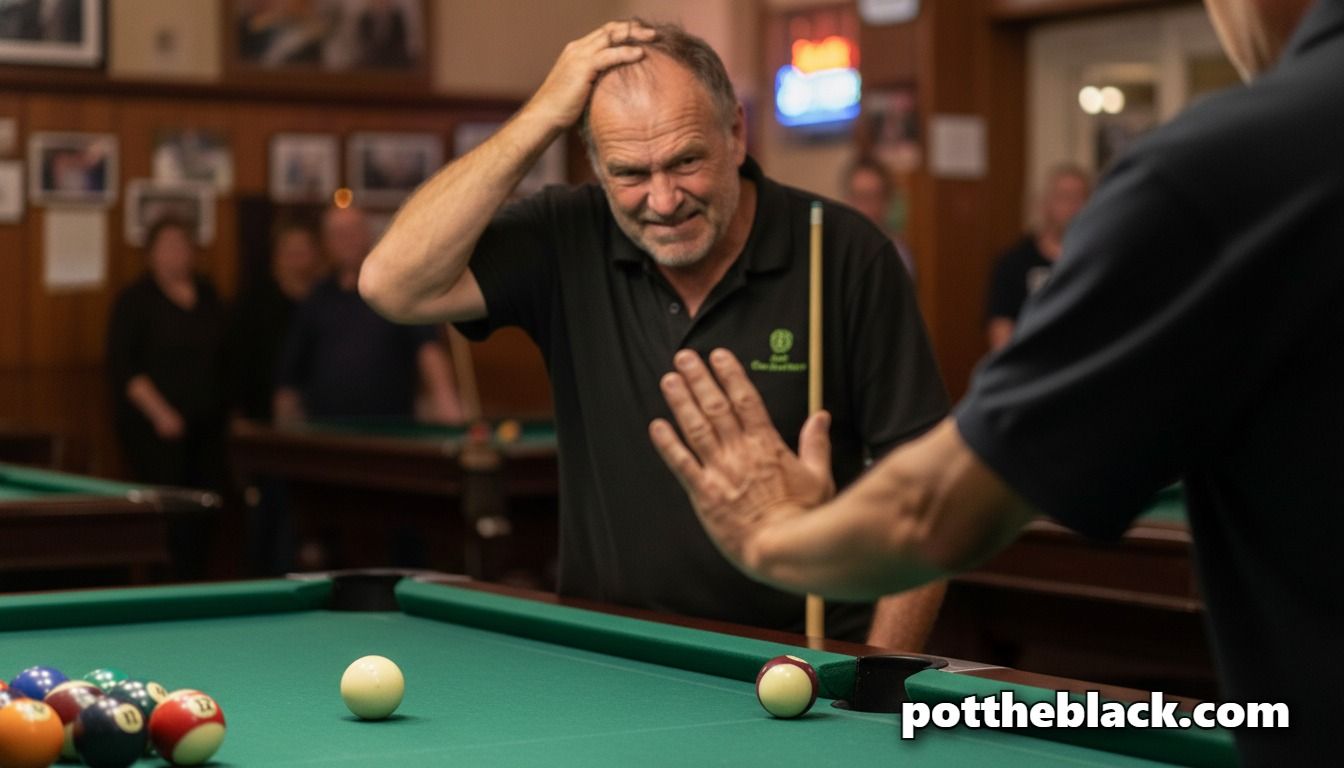
The Ruling: In almost every competitive format (WPA, Blackball, VNEA), this is a foul.
- The Law: After the cue ball makes contact with your "on" ball, at least one ball (the cue ball or any object ball) must strike a cushion.
- Why? To stop "tapping." Without this rule, you could just lean your ball against the opponent's ball and leave them stuck forever. It forces you to actually play the game.
Rob’s Take: This is the one that catches out the "social" players. They think as long as they hit their ball, they’re safe. Wrong. If it doesn't hit a rail, you’re handing the cue over.
4. The "Black Ball on the Break"
The Problem: You smash the rack and the 8-ball flies into the corner pocket. You start celebrating. Your opponent says you’ve lost the game.
The Ruling:
- WPA Rules: It’s not a win or a loss. The 8-ball is spotted (put back on the spot) or the balls are re-racked. The breaker keeps going.
- Many Pub Rules: 8-ball on the break is an instant win.
- VNEA/Valley Rules: It’s a win, unless you also scratch (foul) the cue ball, in which case it’s a loss.
Rob’s Take: Getting the black on the break is 90% luck and 10% rack-tightness. In a serious tournament, it shouldn't end the game. We’re there to play pool, not a lottery.
5. The "Frozen Ball" Argument
The Problem: The object ball is already touching the cushion. You hit it, but neither the cue ball nor the object ball hits another cushion. Your opponent calls a foul. You say, "It hit the cushion!"
The Ruling:
- Standard Rule: If a ball is "frozen" (touching the rail), that rail doesn't count for the "must hit a cushion" rule unless the ball leaves that rail and comes back to it, or another ball hits a rail.
- The Verification: You have to announce the ball is frozen before the shot. If there's doubt, get a third party to look at it.
Comparison of Governing Bodies
To make it easier, I’ve put together a quick look at how the different "Big Bosses" of pool handle common fouls.
How to Prevent the Blow-up
Here’s the "Dad" advice. Most disputes happen because of ego, not the rules.
Call a Referee: If you’re at a tournament, don't guess. Stop. Call the ref. If there is no ref, find the most experienced player in the room and ask them to watch the hit.
State your Intent: If you're playing a thin snick or a shot where the balls are close, say to your opponent: "I'm hitting the red first here, watch the hit." It sets the expectation.
The "Respect" Rule: If you’re playing at a club you’ve never been to, ask: "Are we playing World Rules or Pub Rules?" It takes ten seconds and saves ten minutes of arguing later.
At the end of the day, pool is a game of honor. If you think you fouled, you probably did. Own it. It’ll earn you more respect in the Papatoetoe RSA than winning a frame on a technicality ever will.
Keep your bridge hand solid and your eye on the contact point. Cheers.
References & Rulebooks
More from the Table
Cue Sports Weekly - Wu Yize Wins Shenzhen, O'Sullivan Gets His Lifeline, and the Race for York Tightens
Cue Sports Weekly - Brennan Takes the 8-Ball Worlds, Shenzhen Open Hits the Last Eight