Who Invented 8-Ball Pool? The Real History, Explained
No single person invented 8-ball. There's no patent, no inventor's name attached to it, no single moment you can point to. It took shape in the United States around 1900, evolving out of an older game called pyramid pool, once two changes stuck: the black ball had to be pocketed last, and each player could only pot half the object balls. That's the whole invention, really. Two rules.
But knowing the what doesn't tell you the why. 8-ball didn't arrive fully formed. It evolved — slowly, messily, driven by gamblers who wanted faster games, bar owners who wanted smaller tables, and a sport that kept nearly dying and then somehow refusing to stay dead.
This is that story.
Where It All Started: The Gambling Rooms of the 1800s
To understand 8-ball, you need to know what came before it.
In 19th century America, pool halls weren't the leisure spots you know today. The word "pool" itself comes from gambling — a poolroom was originally a betting parlour for horse racing, and billiard tables were installed so patrons could pass the time between races. The game got attached to the room, and the name stuck.
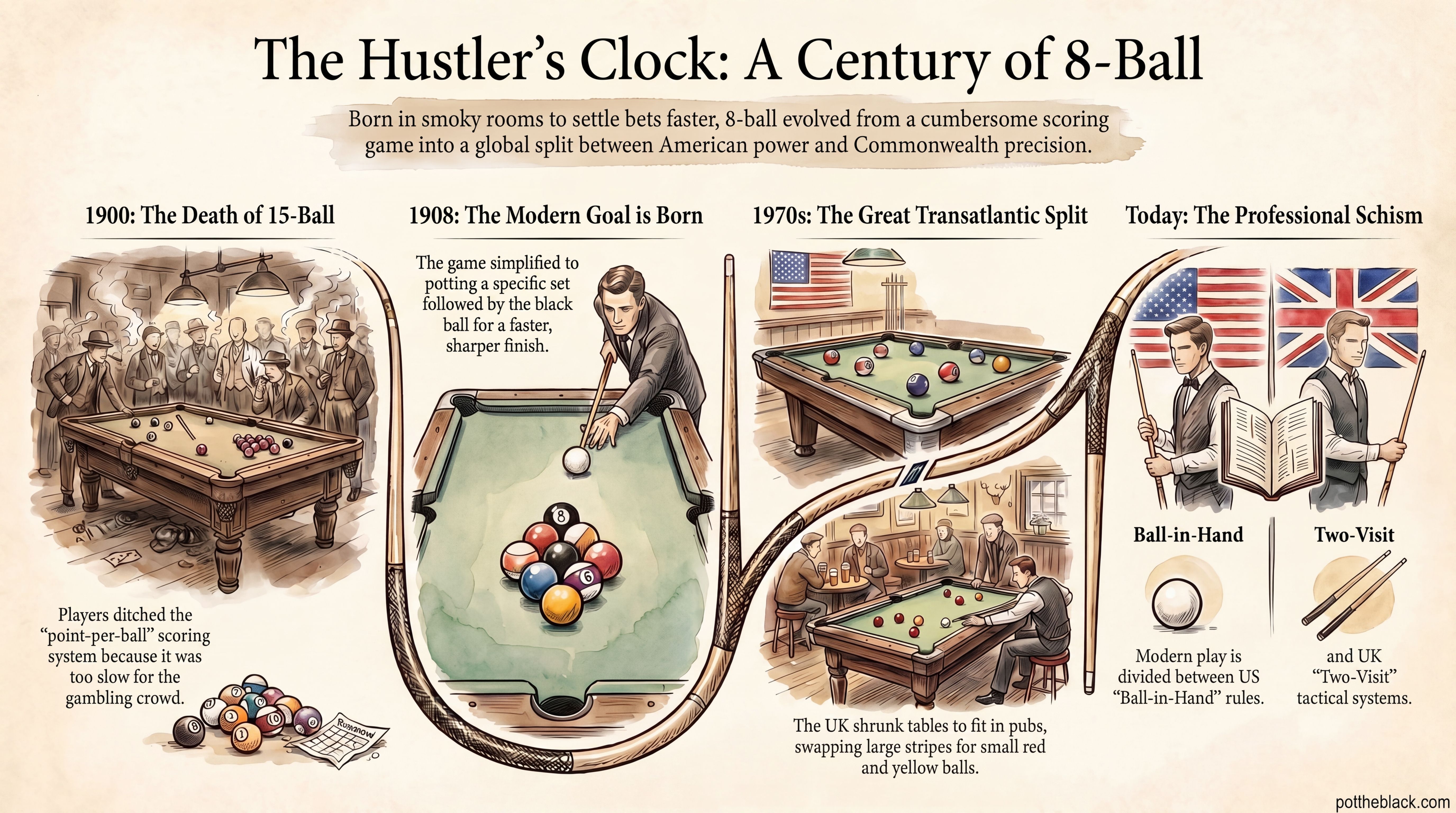
The dominant game through the 1870s and 1880s was Fifteen-Ball Pool. You'd pocket a ball and score points equal to its number. The total value of all fifteen balls in a rack adds up to 120, so the first player to reach more than half — 61 points — won. This game, also called "61-Pool," was used in the first American championship tournament in 1878. T
It was fine, but it had a problem: tracking the score was a headache, and the scoring made no intuitive sense to a casual crowd watching over someone's shoulder.
In 1888, a simpler idea replaced it. Instead of counting the value of balls, you counted the number of balls pocketed. The player who sank the last ball of a rack would break the next rack and carry their total forward continuously — hence the name "Continuous Pool."
But even that wasn't quite right. The scene still wanted something faster, something you could finish in one sitting without a scorekeeper.
Around 1900: The Two Changes That Created the Game
8-ball arose around 1900 in the United States as a development of pyramid pool. The game essentially came from two key changes: the 8-ball must be pocketed last to win, and each player may pocket only half of the object balls.
That's it. Two rule changes. And from that, the most popular cue sport in human history.
By 1925, the game had grown popular enough that Brunswick-Balke-Collender — the dominant table manufacturer of the era — introduced purpose-made ball sets: seven red, seven yellow, one black, and a cue ball. The idea was that spectators could more easily see which suit belonged to which player. Those colour choices didn't stick for the American version (which settled on the numbered solids and stripes we know today), but they did eventually become standard in the British variant — more on that shortly.
The Lean Years: Pool Nearly Died
Here's the part most history articles gloss over.
Pool was hugely popular from the turn of the century through World War II. By the late 1920s, there were an estimated 40,000 pool halls across the United States. That's a staggering number. Then the war ended, soldiers came home, got married, bought houses in the suburbs, and the game cratered.
Despite the best efforts of the Billiard Congress of America, the sport fell into a depression in the late 1940s and through the entire 1950s. Poolrooms closed. The image of the game became seedy — somewhere between a gambling den and a place you sent your troubled teenager to finish off their prospects.
But then something happened.
1961: The Hustler Saves the Game
On September 25, 1961, a film came out that changed everything.
The Hustler is a 1961 sports drama starring Paul Newman as small-time pool hustler "Fast Eddie" Felson, who challenges the legendary Minnesota Fats, played by Jackie Gleason. It's a dark, gritty, slow-burning film set in the kind of pool halls where the lights are too yellow and everyone has a cigarette going.
Willie Mosconi — the reigning champion of the era and a genuine legend of the sport — served as technical advisor. His job was to teach Newman how to walk, talk, and shoot like a real pool player. Newman had never even picked up a cue before filming began.
Executives at Brunswick, the company that made most of America's pool tables, were furious. They threatened to fire Mosconi for his involvement, believing the film would set the industry back 150 years.
They were spectacularly wrong.
Within six months of the film's release, approximately 2,000 new pool centers opened across the United States — a 25 percent increase in the total number of pool halls in just half a year, reversing decades of decline.
The Hustler didn't just make people like pool. It made people want to play it. It's no accident that this era also produced the sport's most enduring mythology — the pool hustlers and sharks who worked bars and pool halls for a living, hiding their real skill until the money was on the table, and whose reputation the film both drew on and cemented for good; decades later, the game those hustlers played has settled into a much more regulated modern form, right down to how a foul gets called in 8-ball today.
The Coin-Op Revolution: Why 8-Ball Won
This is probably the most underrated chapter in the game's history, and it's the direct reason why 8-ball became the dominant form rather than any other variant.
8-ball took root as a bar game largely because of the decline of straight pool and the introduction of smaller coin-operated tables during the 1950s. Straight pool — which requires tracking long runs of consecutive pots — doesn't work well on a small bar table with strangers waiting to play. 8-ball does. It has a clear endpoint, a dramatic finish (the black), and you can play a full game in ten minutes.
Companies like Valley and Dynamo began manufacturing thousands of coin-operated tables. Bar owners got steady income with almost no maintenance needed. Operators could drop a table anywhere and collect. A game of pool became something you could play at the pub on a Tuesday night. And when that happened, the version of pool you played at the pub became 8-ball.
The leagues — APA and BCA — grew straight out of bar culture, giving casual players a way to compete without leaving their local haunt.
1978: The Match Twenty Million People Watched
The Hustler had turned pool into a cultural moment. But the game needed a real, live spectacle to push it to the next level.
It got one.
On Valentine's Day, 1978, twenty million Americans tuned in to ABC's Wide World of Sports to watch Willie Mosconi face Minnesota Fats at the Waldorf-Astoria Hotel in New York City. Howard Cosell was at the mic. The prize was $15,000. Mosconi won all three sets, including an eight-ball set, beating Fats 5–2, 5–3, and 5–2.
It became the most-watched pool competition in US history.
Then in 1986, The Color of Money came out — the sequel to The Hustler, again starring Paul Newman, this time alongside Tom Cruise — and the whole cycle happened again. Another generation discovered pool. Another wave of new players walked into halls.
Pool kept dying and kept getting saved by culture.
The UK Split: How Blackball Was Born
Meanwhile, on the other side of the Atlantic, something different was happening.
The British version of eight-ball evolved into a separate game, retaining elements of earlier pub versions with additional influences from English billiards and snooker. It uses unnumbered, solid-coloured object balls — typically red and yellow — with the one black 8-ball. The balls are 2 inches or just over in diameter, matching the size used in snooker.
The pub pool boom in the UK from the 1970s onward drove all of this. Bar owners wanted tables that fit next to the dartboard, not the massive American tables. In 1976, the British Association of Pool Table Operators (BAPTO) published the first standardised set of rules for use in national events. The English Pool Association followed in 1978 with their own standardised rules, used through county structures for decades.
The game that emerged looks like 8-ball, plays like 8-ball, but has a different heartbeat. The standard penalty for a foul is two visits — meaning your opponent gets two shots. That single rule completely reshapes how you think about defence. In American pool, a foul is a bad miss. In Blackball, a foul is a crisis.
If you've played club pool in New Zealand, Australia, the UK, or Ireland, this is probably the version you know. Reds and yellows. Call the black. Two shots for a foul.
The Rules Chaos (And Why It Still Exists)
One of the great ongoing arguments in 8-ball is which ruleset actually applies. And the honest answer is: it depends where you are, and sometimes just which table you're standing at.
At the professional level, there are two main standards:
The WPA (World Pool-Billiard Association) governs American-style 8-ball worldwide. It's a call-shot game. Obvious shots in obvious pockets don't need to be announced, but anything requiring a bank or combination shot does. Slop doesn't count.
For Blackball/English pool, the WPA publishes its own ruleset. But since 2022, the International Eightball Pool Federation (previously known as the World Eightball Pool Federation) has adopted a new "International Rules" standard used at all levels in EPA and WEPF tournaments.
And then below all of that, there's the informal layer. Millions of players use informal "house rules" which vary not just from area to area, but from venue to venue.
I've played in New Zealand RSA competitions where "two shots" means two visits, and in the same city found clubs where two shots means you can't miss on the first one. Same game. Completely different tactical implications.
This isn't a bug in the sport. It's almost a feature — pool adapts to its environment in a way most sports don't.
The Equipment Revolution
The game changed because the gear changed. You can't separate the two.
Early balls were ivory — expensive, inconsistent, and they warped over time. The search for a synthetic substitute actually had a surprising consequence: it's credited as one of the drivers toward the development of plastic as a material. John Wesley Hyatt, a New Yorker, developed celluloid partly in response to early billiard ball manufacturing challenges.
Modern phenolic resin balls — Aramith being the gold standard — are far more consistent, last far longer, and transfer energy more cleanly. The cloth got faster. Slate replaced wood and gave tables a true, level surface that wood simply couldn't guarantee. Cues went from rough timber to precision-engineered shafts with low-deflection tips designed for specific types of spin.
All of this matters, because the modern game of 8-ball isn't just about potting — it's about where the cue ball goes after every single shot. Position play. Break construction. Safety architecture. None of that becomes genuinely possible until the equipment can deliver repeatable, predictable results. On an old warped table with ivory balls, you were playing a different game.
Today: One Game, a Hundred Formats
8-ball is now the most played cue sport on earth. It's on phones (Miniclip's 8 Ball Pool was recognised by Guinness World Records as the most downloaded mobile pool game, with over 796 million downloads by 2021). It's in living rooms, pubs, sports bars, community halls, and RSA clubs from Auckland to Aberdeen.
The professional scene has fractured somewhat — WPA World 8-Ball Championships, IEPF events for English pool, various league structures running their own circuits — but the game at street level has never been more accessible. You can walk into almost any bar on earth, find a table, and play a game in fifteen minutes without knowing anything except the basics.
That accessibility is what 15-Ball Pool was always trying to achieve, and kept failing at. The gambling rooms of the 1880s wanted a game people could play fast, understand quickly, and come back to.
They just took a hundred years to get it exactly right.
FAQ.
Who invented 8-ball pool?
Nobody invented it outright. It developed in the United States around 1900 as an offshoot of pyramid pool, once two rule changes became standard: the black ball had to be potted last, and each player could only pocket half the object balls.
When was 8-ball pool invented?
Around 1900, though it didn't take its modern form overnight. By 1925, Brunswick-Balke-Collender was already selling purpose-made ball sets for the game, so it was well established by the mid-1920s.
Where did 8-ball pool originate?
In the United States. It grew out of pyramid pool, which itself came from 19th-century gambling parlours where the game "pool" got its name.
What game came before 8-ball?
Pyramid pool, and before that, Fifteen-Ball Pool (also called 61-Pool), where players scored points equal to the number on each ball they potted.
Why is it called 8-ball?
Because the black 8 ball is the deciding ball of the game — pot it last and legally, and you win the frame. Pot it early or in the wrong pocket, and you lose.

About Rob St George
Rob St George has been playing pool and snooker at club level for over two decades. Based in Auckland, he created Pot The Black to be the definitive technical resource for serious cue sports players — covering everything from shot mechanics to competitive rules, without the fluff.
More from the Table
Cue Sports Weekly - Wu Yize Wins Shenzhen, O'Sullivan Gets His Lifeline, and the Race for York Tightens
Cue Sports Weekly - Brennan Takes the 8-Ball Worlds, Shenzhen Open Hits the Last Eight