Official Snooker Rules: The Complete Guide for Players.
Snooker fouls cost your opponent 4–7 points and leave the balls exactly where they are — no ball-in-hand like in pool.
- Point values run Red (1), Yellow (2), Green (3), Brown (4), Blue (5), Pink (6), Black (7) — always in that order.
- Foul and a miss: if you don't make a genuine attempt to hit the ball on, the ref can call a miss and make you replay the shot from the same spot.
- Jump shots are illegal in snooker — if the cue ball leaves the bed of the table to clear an obstruction, it's a foul, even if you still hit the object ball.
- Touching ball: if the ref calls it, you must play away from that ball without moving it — you've already made contact, so just play safe.
- Free ball: if a foul leaves you snookered, you can nominate any ball on the table to stand in for the one you were meant to hit.
Official Table & Ball Specs — WPBSA
Cross-checked against the WPBSA Official Rulebook (PDF)
Last updated 24 August 2026 | Cross-checked against the WPBSA Official Rules of Snooker and English Billiards
Every snooker club has that one bloke who's "pretty sure" about the miss rule but goes quiet the second someone asks him to actually explain it. This is the page for settling that argument. Not a highlight reel of the weird bits — the whole rulebook, in order, in plain English.
The Table and the Balls
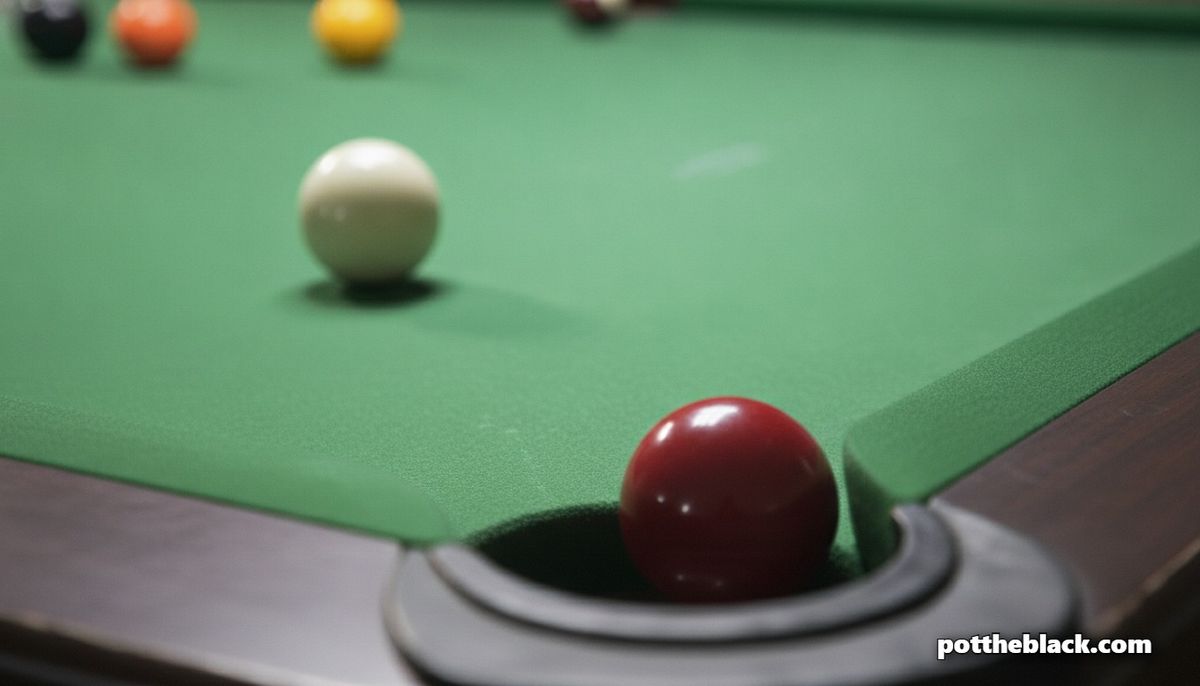
A full-size table is 12 feet by 6 feet, with six pockets — one in each corner, one in the middle of each long cushion. You're playing with 22 balls: one white cue ball, 15 reds worth a point each, and six colours worth 2 through 7.
The official numbers are more exact than most players ever need to know, but they matter if you're setting up a competition table or just settling an argument about whether your club's table is regulation size. The playing area inside the cushion faces measures 11'8.5" by 5'10", with the cushion rail sitting 34 inches off the floor. The baulk line runs across the table 29 inches from the bottom cushion, and that's where the D comes from — a semicircle with a 11.5-inch radius, drawn out from the centre of that line. Every ball is 52.5mm in diameter, and it's the same ball size across reds and colours, so nothing on the table is bigger or smaller than anything else.
Here's the full point scale:
- Red — 1 point
- Yellow — 2 points
- Green — 3 points
- Brown — 4 points
- Blue — 5 points
- Pink — 6 points
- Black — 7 points
Memorise it in that order and you'll never get caught out mid-break asking what the blue's worth.
Setting Up: Where Every Ball Actually Goes
Get this wrong and you're playing a different game before anyone's even broken off.
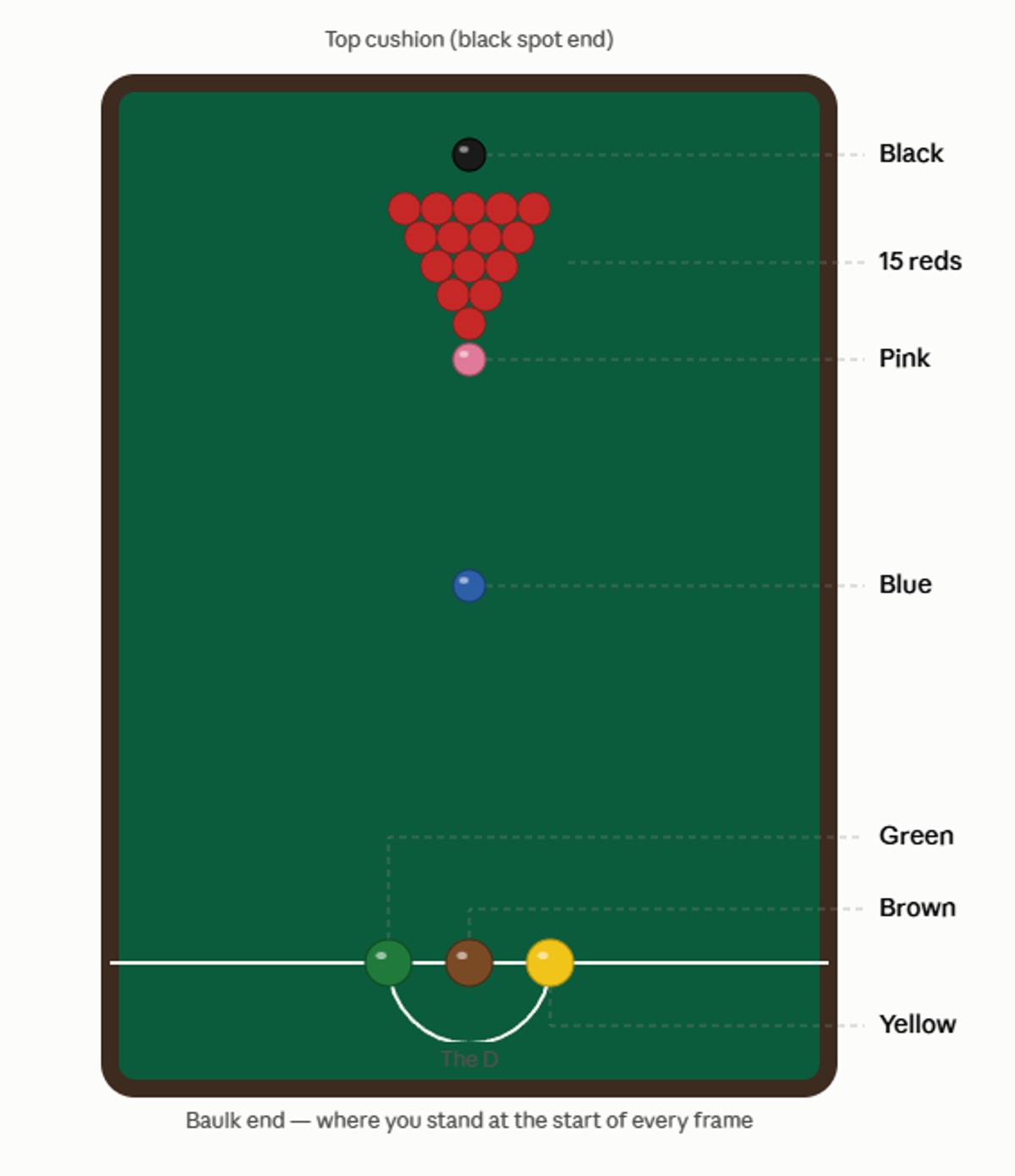
Spot the colours first, since they're the fixed points everything else is measured against. Black goes near the top cushion. Blue goes dead centre of the table. Green, brown and yellow go on the baulk line, in that order left to right, standing at the baulk end. Leave the pink for last — more on why in a second.
The reds go in as a tightly packed triangle, and the trick is getting the gap to the pink right without actually placing the pink first. Rack the fifteen reds, then use the pink itself, held just off to the side rather than dropped on its spot, to judge how far forward the triangle needs to sit. Once the reds are square and the apex is as close as it'll get without touching, that's when the pink goes down onto its actual spot — dropped into the gap you've already left for it, not squeezed in afterward.
Do it the other way round, pink on the spot first, and you're one clumsy nudge from knocking it clean off before the frame's even started. The base of the triangle — the row of five — ends up parallel with the top cushion, up near the black.
How a Frame Actually WorKS
Snooker runs on a cycle, and once you see it, you can't unsee it.
You have to pot a red first. Once that's down, you nominate a colour — any colour — and try to pot that next. If you succeed, the colour gets respotted on its original spot and you go back to hunting for another red. That loop continues until all 15 reds are gone.
Once the reds run out, the game changes shape completely. Now you have to pot the colours in strict ascending order: yellow, green, brown, blue, pink, black. No skipping, no picking your favourite. That's the "clearance" phase, and it's where the big finishing breaks happen.
A frame ends when the balls run out or one player concedes. A match is just a set number of frames, always odd, so there's no chance of a tie.
Fouls and Penalty Points
This is the part that decides most club matches, and it's worth understanding properly rather than half-remembering from YouTube.
A foul happens whenever the striker fails to hit the ball "on" first, hits the wrong ball, pots a ball that wasn't on, sends the cue ball into a pocket, touches a ball with anything other than the tip of the cue, or plays a push shot (where the tip stays in contact with the cue ball for longer than a single clean strike). Standing on the shot with both feet off the floor is also a foul, which surprises almost everyone the first time they hear it.
The penalty for any foul is the highest of three numbers: the value of the ball that was on, the value of whichever ball got fouled, or four points — whichever of those is biggest. That's why the minimum penalty is always four, and the maximum is seven, since you can't foul on anything worth more than the black.
Here's the bit that trips up a lot of pool players moving across: snooker doesn't give you ball-in-hand anywhere on the table after a foul, the way pool does. The incoming player just plays the balls from wherever they've ended up. The only time you get to place the cue ball freely is at the very start of a frame, from inside the D.
Pool vs snooker, side by side:
- Foul penalty — 8-ball gives ball-in-hand, usually anywhere. Snooker awards points (4 to 7) instead, and the balls stay as they lie.
- Free placement zone — 8-ball allows it across the whole table after most fouls. Snooker only allows it from the D, at the start of a frame.
- Jump shots — legal in 8-ball if struck correctly. Illegal in snooker under any circumstance.
Foul and a Miss
If you're snookered and the referee decides you didn't make a genuine attempt to hit the ball on, that's called a miss — and it's separate from an ordinary foul. The consequence is brutal: your opponent can make you play the exact same shot again from the same position, and there's no limit on how many times in a row that can happen in a formal match (though the official rules cap it at five consecutive miss calls before the referee has to intervene differently).
Club play almost never enforces this properly, which is a whole debate on its own — we've gone deep on why the miss rule causes so much friction at club level if you want the full argument.
Touching Ball
If the cue ball ends up physically resting against the ball you're supposed to hit, the referee calls "touching ball." You then have to play away from it without moving it — if it shifts when you strike, that's a push shot foul. Contact with a red in this position already counts as your legal hit, so you can safety off into a cushion and you're covered.
The Free Ball
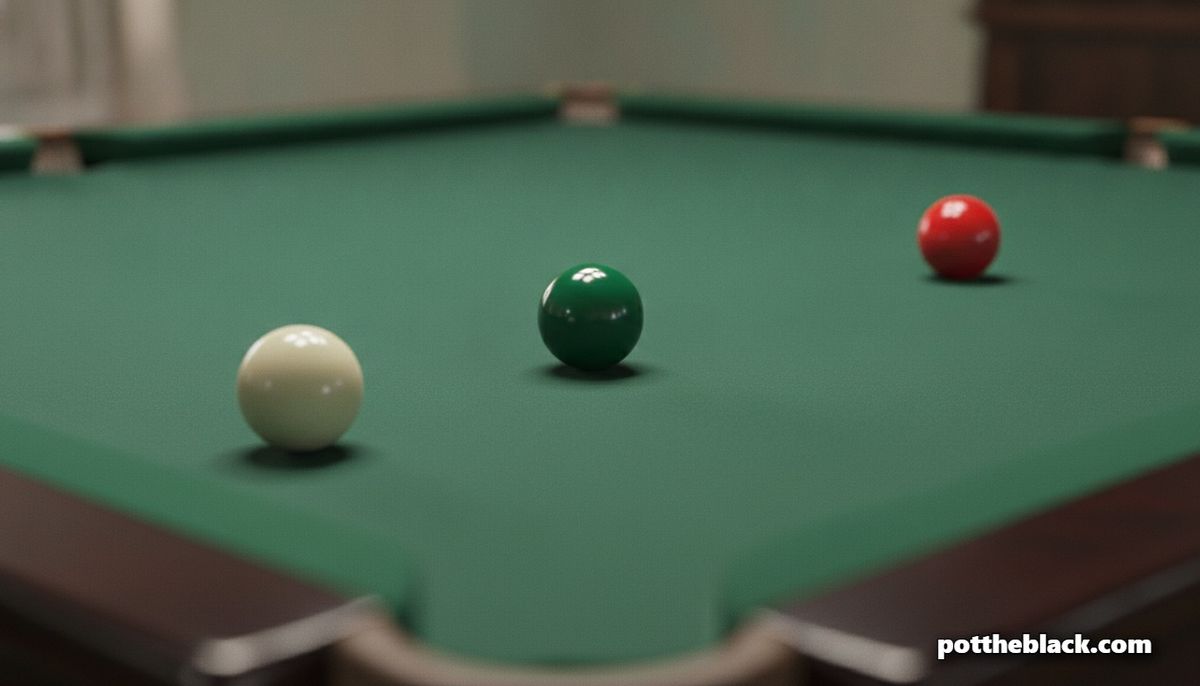
If your opponent fouls and leaves you snookered as a result, you are awarded a free ball. This allows you to nominate any other object ball on the table to act as the ball on. Potting the nominated ball scores the exact value of the actual ball on—meaning a nominated Black scores 1 point if Reds are on, or 5 points if the Blue is the active target. The nominated ball is then respotted, and standard play resumes. It is the rulebook’s mechanism to ensure an opponent's error does not compound into an unearned tactical disadvantage for you.
However, the free ball is not your only recourse. Following any foul, you retain the right to decline the shot entirely and instruct your opponent to play again from the resulting position. If the referee also calls a "Foul and a Miss," you gain the additional leverage to have the balls returned to their original positions and force the opponent to attempt the escape again. The free ball is simply an extra tactical option at your disposal, not a compulsory obligation.
Respotting Colours
When a colour gets potted mid-break, it goes back on its own spot. But snooker tables are small and balls end up in strange places, so there's an official order of fallback spots when the original one is blocked. This trips up more players than almost any other part of the rulebook, which is exactly why we wrote a dedicated respotting guide — it's too fiddly to squeeze into a paragraph here and do it justice.
Ending a Frame: Concession and Needing Snookers
Once all the reds are gone and you're deep into the colours, the maths gets simple fast. If your opponent is ahead by more points than are left on the table, you're in "snookers required" — the only way back is to force fouls and hope for the best.
Most club players know this stage as "playing for snookers," and there's real etiquette around when to keep going versus when to shake hands and concede. If you're regularly finding yourself needing three or more snookers with only a handful of balls left, it's usually the moment to concede rather than drag the frame out. If you're on the other side of that scoreline and want to actually close matches out against better players, this breakdown of tactics against a superior opponent is worth a read.
What Happens When the Frame Is Tied? The Respotted Black
This is exactly what happened at the China Open this week. Zhao Xintong and Zhang Anda went the distance in their first-round decider, and by the time the last colour was potted, the frame was locked at 64-64. Every red gone, every colour gone except one.
Just happened at the China Open
Zhao Xintong vs Zhang Anda went to a respotted black at 64-64 in their first-round decider at the 2026 China Open in Taiyuan. Zhang won it. If you're here after watching that finish, this is the rule that decided it.
When that happens, the black goes back on its spot. The referee places it exactly where it started the frame, and the two players draw lots, usually a coin toss, to decide who gets first crack at it. Whoever wins that toss gets the cue ball in hand from inside the D, same as the start of any frame.
From there it's sudden death. First pot wins the frame outright. First foul hands the frame to the other player, penalty points and all, no matter how many points were on the table a moment ago. There's no second attempt and no safety battle once it's down to this, since there's nothing left to play safe with. It's one ball, one shot, one outcome.
Zhang got the black in and took the frame. Zhao described it afterwards as a match where he'd had chances in the closing frames and didn't take them, which is usually how these ones go, since a respotted black tends to punish whoever missed their moment earlier rather than reward brilliance in the moment itself.
This is a different situation to the everyday kind of respotting, where a colour gets potted mid-break and simply goes back on its own spot so play can continue. If you want the full rundown on what happens when that spot is already occupied by another ball, we've covered the fallback order in detail here.
Where These Rules Actually Come From
Every rule on this page is cross-checked against the current official rulebook maintained by the World Professional Billiards and Snooker Association, the sport's global governing body. Snooker's own history explains why the rules are this precise — the game was formalised by British Army officer Neville Chamberlain in 1882, and it's carried that level of procedural detail ever since, according to historical records of the sport's origins.
If you want the source document itself rather than our breakdown of it, the official WPBSA rulebook is available as a free PDF — worth keeping bookmarked if you referee club matches.
FAQ.
What happens if you foul in snooker?
Your opponent is awarded penalty points — a minimum of four, up to a maximum of seven depending on which ball was involved — and the balls are left exactly where they are. There's no ball-in-hand like in pool.
How many points is a foul in snooker?
At least four points, and up to seven if a higher-value ball (blue, pink, or black) was involved in the foul. The exact number is whichever of the ball-on value, the fouled-ball value, or four points is highest.
What is the miss rule in snooker?
If a referee decides a player didn't genuinely try to hit the ball they were on, they can call a miss. The opponent can then require the same shot to be replayed from the same spot, which can happen several times in a row in a formal match.
Can you win a snooker frame without potting all the balls?
Yes. If your opponent is far enough behind that they can't realistically catch up even by forcing fouls, they'll usually concede the frame before every ball is potted.
What's the difference between a foul in snooker and a foul in pool?
The penalty structure is completely different. Pool typically gives the incoming player ball-in-hand anywhere on the table. Snooker instead awards points and leaves the balls in place, with free placement only available from the D at the start of a frame.
What happens if a snooker frame is tied after the black?
The black is respotted on its own spot, and the players draw lots or toss a coin to decide who plays first. Whoever wins gets the cue ball in hand from the D, and the frame ends on the first pot or the first foul, whichever comes first.
Who breaks first when the black is respotted in a tie situation?
There's no fixed rule based on who potted what earlier in the frame. It comes down to a coin toss or drawn lots between the two players, and the winner chooses to play first.