1,200 Newtons of Force: The Mathematical Blueprint for the Perfect 8-Ball Break
The Paradox of Force
It is the only shot in cue sports where you are explicitly required to swing the cue with maximum velocity, yet you are simultaneously required to deliver the cue ball to a precise millimeter of target area.
It is a paradox of force and precision. We’re not teaching you "how to break"; we’re giving you the Mathematical Blueprint for a Perfect 8-Ball Break.
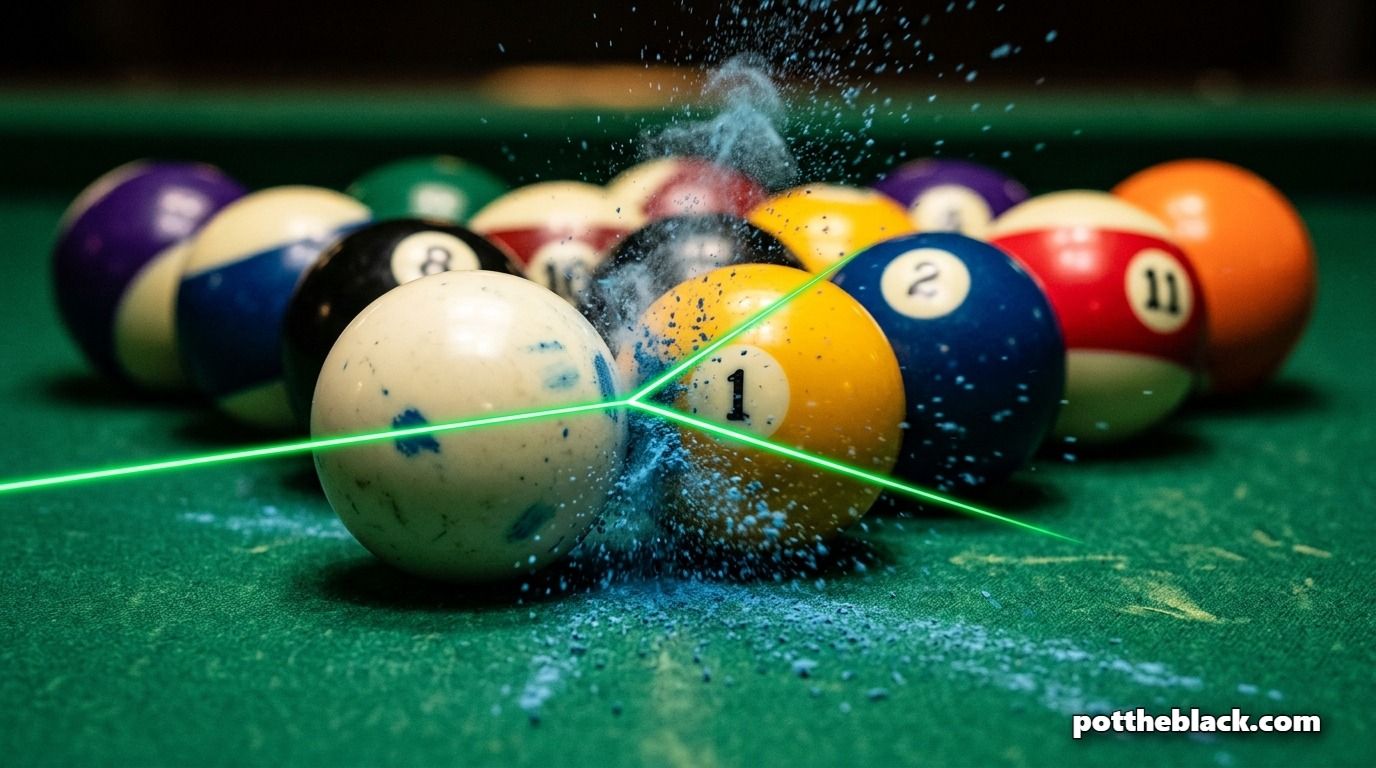
When a world-class professional executes a break, the system generates over 1,200 Newtons of force.
That’s equivalent to being struck by a heavyweight’s punch. It’s not about strength; it’s about Kinetic Energy transfer ($KE = \frac{1}{2}mv^2$).
But force without control is useless. This is the science of breaking.
The Logarithmic Tradeoff: Velocity vs. Accuracy
The greatest enemy of the powerful break is unintended spin. The relationship between speed and accuracy in pool is logarithmic. At slow speeds, the range of acceptable strike points on the cue ball to avoid unintended "squirt" or English is relatively broad. As the cue velocity increases, that target area shrinks exponentially.
Never as easy as it looks
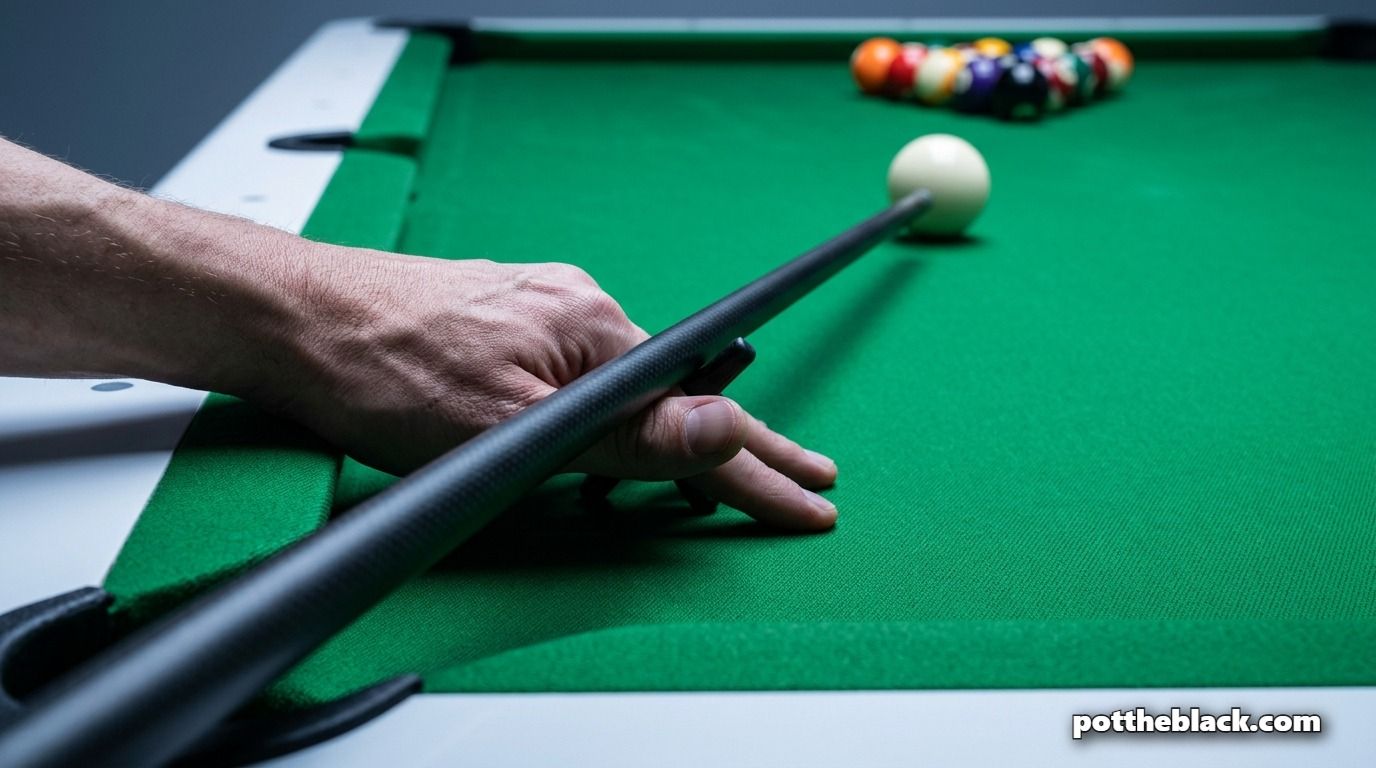
A perfect central strike is paramount. If your cue tip hits even 1 millimeter off-center at professional speeds, the resulting "unintended deflection" can cause the cue ball to miss its primary target by inches, leading to kicks, clusters, and, most commonly, scratching the cue ball off the side rail. A pro player hits at 95% velocity not because they can't go to 100%, but because they can maintain 99% central strike consistency.
Anatomy of the Target: Geometry over Power
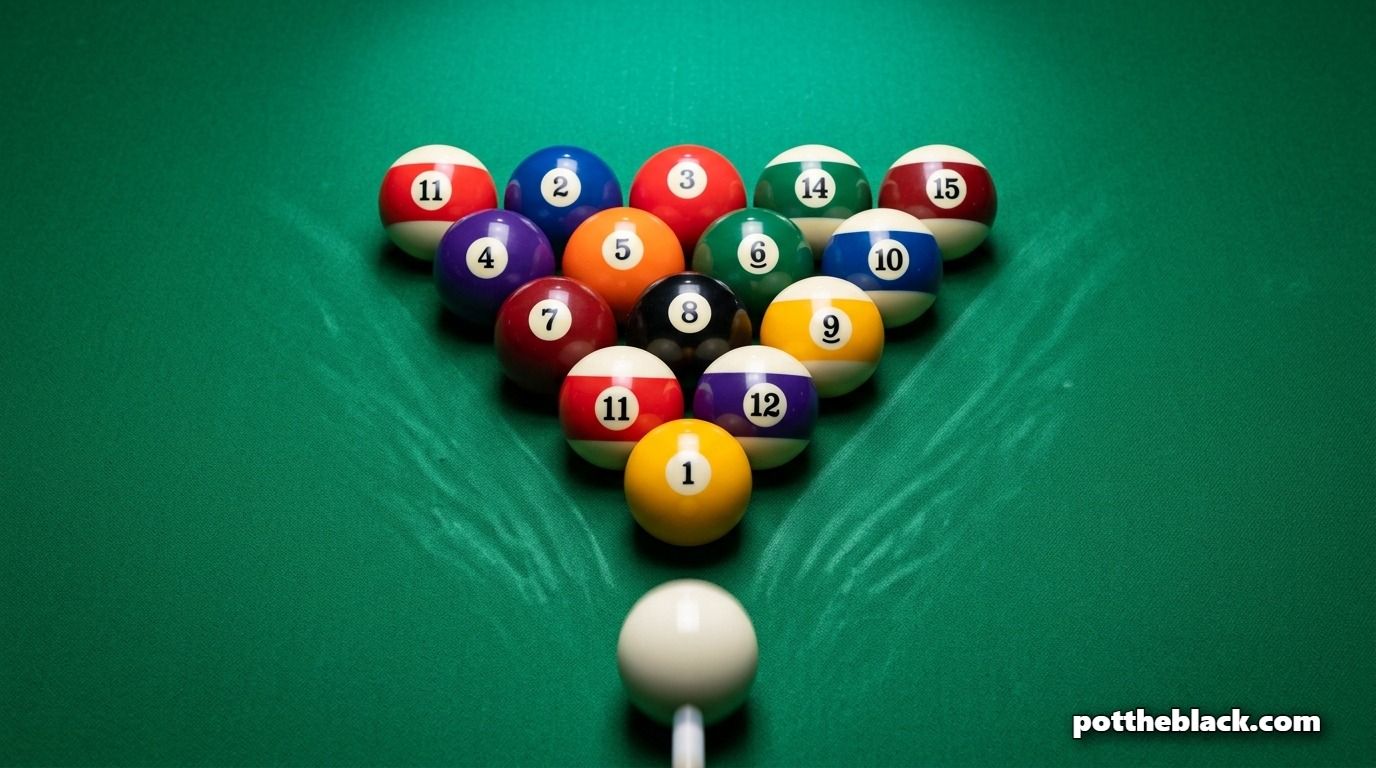
In WPA standard 8-Ball, the rule regarding a legal break requires either pocketing a ball or driving at least four numbered balls to the cushion. The geometry of the standard triangle rack means that the lead ball (the '1' ball) is the primary target.
Top professionals do not strike the 1-ball perfectly "full." Doing so reflects maximum energy directly back to the cue ball, often causing it to kiss another ball and scratch in the side pocket. Instead, the mathematical standard is a "quarter-ball offset" hit (hitting roughly 3/4 of the lead ball). This creates a wider dispersal angle for the rest of the pack while simultaneously "holding" the cue ball closer to the center of the table.
Furthermore, the vertical strike point on the cue ball is critical. You must strike slightly above center (with natural "follow" or topspin). This natural spin allows the cue ball to drive "through" the lead ball, rather than bouncing back.
The Masterclass Execution: Stance and Bridge
Our ultimate recommendation isn’t just about speed; it's about stability. Here are the best 8 ball break tips from a mathematical perspective. Treat your body like a tripod and your cue like a pneumatic ram.
- The Stance: Your stance must be significantly wider than a standard shot. This creates a stable platform for high-velocity motion. Shift your center of gravity slightly forward, preparing to drive your energy "into" the cue ball.
- The Bridge: At breaking speeds, a rail bridge or a closed tripod bridge on the felt is the only way to lock the cue shaft to a consistent vertical plane. A millimeter of vertical wobble translates to critical inaccuracy.
The Punch, Not the Swing
Amateurs "swing" their cue; professionals "punch" it. Shift your goal from maximum velocity to maximum acceleration at contact. The most common failure is reaching peak velocity before contact and decelerating as the tip hits the cue ball.
The "blueprint" demands that your velocity is still increasing at the moment of collision, maximizing momentum transfer.
A great 8-Ball break isn’t a skill you are born with; it is a practicable engineering discipline.
Treat your break with a data-driven mindset. Track your speed, analyze your central strike success rate, and perfect your target acquisition. The perfect break is not luck; it’s a numbers game you are destined to win.
More from the Table
Cue Sports Weekly - Wu Yize Wins Shenzhen, O'Sullivan Gets His Lifeline, and the Race for York Tightens
Cue Sports Weekly - Brennan Takes the 8-Ball Worlds, Shenzhen Open Hits the Last Eight